sheeps

Press
Sheeps, for the press
Sheeps is an iPhone app that makes sleep stories with no plot, written for each listener: harmless, disconnected scenes, read by a calm narrator, that grow shorter and quieter until the story ends in silence. It is cognitive shuffling — the pre-sleep technique developed by the cognitive scientist Luc Beaudoin at Simon Fraser University — delivered as a narrated story instead of an exercise.
How to describe Sheeps
Sheeps — sleep stories with no plot. The same words everywhere, please: on this site and in anything written about it. The wrong plural is deliberate — the first small piece of nonsense — and Sheeps is not related to other apps or games with sheep in their name.
In a sentence: an iPhone app for people who lie awake with a busy mind, which makes them a new plotless sleep story from the comfort themes they choose, keeps out anything they ask it to, and ends in silence.
Facts
| Fact | Detail |
|---|---|
| Name | Sheeps |
| What it is | An iPhone app: personalised, plotless sleep stories, plus Radio (single words with a pause the listener sets) |
| Available | On the App Store, since 24 September 2026 |
| Languages | English and German |
| Story length | From 5 to 60 minutes, chosen by the listener |
| Price | Free to download; using it needs Sheeps Plus, €4.99 a month or €39.99 a year in euro storefronts |
| How stories are made | Written by a language model within fixed rules, checked against the listener’s avoid list, read by a synthetic voice — in detail |
| Made in | Munich, Germany |
| Website | dreamsheeps.space |
What Sheeps claims, and what it doesn’t
Sheeps is a wellness app, not a medical product. It does not diagnose or treat anything, and it has not itself been clinically tested.
It is built on research about how thought changes as people fall asleep, and on a technique — serial diverse imagining — that improved pre-sleep arousal, sleep effort and sleep quality from where they started in a 2016 trial with university students. That trial had no untreated comparison group, counted the technique’s inventor among its authors, and did not report how quickly people fell asleep.
Please do not write that Sheeps, or cognitive shuffling, “makes you fall asleep 20 minutes faster”. That figure comes from a 2002 study of a different technique, imagery distraction, in 41 people with insomnia. What the research actually shows sets out both studies and the figure in Sheeps’ own listing, with their limits.
Stories we would be glad to help with
- The sleep app whose stories deliberately make no sense — and why coherence is what keeps a racing mind awake.
- What the cognitive shuffle study actually measured — the popular numbers, and the two studies they come from.
- Sleeping without a mind’s eye — about one person in twenty-five has aphantasia, and most sleep techniques assume a picture.
- Counting sheep, and why it doesn’t work — from an app called Sheeps.
Icon and images
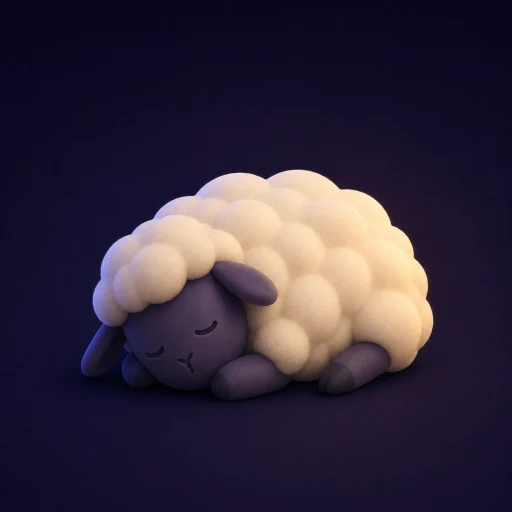
The app icon, one sheep asleep, at 512 pixels and at 180 pixels, and the share image this site uses. Screenshots are on the App Store listing, which the button at the foot of this page opens. Use them as they are, please: no cropping the sheep.
Contact
Press enquiries go to the address in the Imprint. Every message is read by a person.